

If I could package the benefits of strength training into a little pill and put it on the shelves, it would sell out faster than you could say "longevity" and I would have so much frickin money I could buy the Vancouver Canucks.
Let me ask you all a question: if strength training did nothing to change your appearance, would you still do it? Like you still get all the health benefits, but your appearance stays exactly as it is right now, would you still lift weights?
Too many people out there would say no to that question. We've let the media turn strength training into a never ending vanity contest that nobody can win because the goal posts never stop moving.
I get it though, it's a lot more eye catching to print "giant, rock hard ass" on a magazine cover than it is to print "giant, rock hard bone...s."
(Woah, a little close to an R rating on that one.)
We've arrived back at society's obsession with looks and vanity.
Listen, I'm not against wanting to look a certain way, for a long time that was the only reason I lifted weights, but I am against that being your ONLY concern and pushing aside your health to do so. Believe it or not, a lot of people out there resort to very unhealthy tactics to achieve their "dream body". Steroids are rampant, overly restrictive diets are everywhere and people exercise themselves into the ground, all to fit a forced societal narrative.
Then we have the other side of the spectrum: people who don't care about the way they look so they don't exercise at all.
It's a really great thing to not be attached to a certain body image, it's not a great thing to push exercise to the side because of it. Thinking that the only purpose of exercise is to burn calories and make your body look good is a great recipe for having extreme difficulty with life as you age.
This was my very long winded introduction into the purpose of this article which is to tell you all why you need to be lifting weights without even thinking about aesthetics.
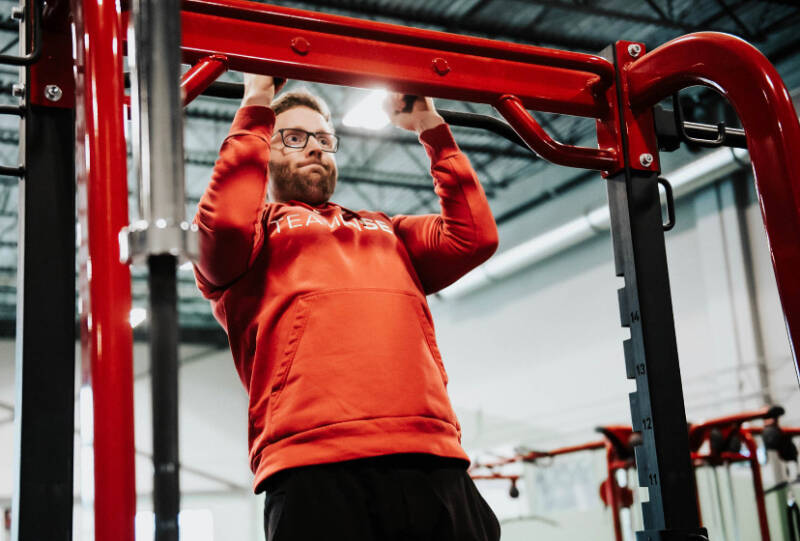
In case you're new here hi, I'm Justin. I'm a triple certified personal trainer and nutrition coach and I've been working in this business since 2015. In that time I've helped hundreds of people just get strong as f*ck and have an easier time with life.
There is quite simply nothing on this planet that can replicate the benefits of strength training. All forms of movement and exercise are beneficial, but nothing else out there does what lifting does. The best part? You don't need to lift that much to see these benefits.
Bones. We all have em. Lots of em actually. When we get right down to it our bodies are really just sentient sacks of bones.
Now raise your hand if you've seen what an injury to one of your bones does to your life.
What if I told you that simply lifting weights a couple times a week could make those injuries way less likely? We can never turn our risk down to zero of course, but we can substantially reduce it.
I'm talking about osteoporosis here folks.
In case you're unfamiliar, osteoporosis is a condition involving the degeneration of our bones making them weaker, more brittle and more susceptible to damage.
Osteoporosis is presented to the world as an old person problem, but that's just when it becomes the most apparent. That person in their 60s or 70s with osteoporosis started as a person in their 30s that didn't take proper care of themselves.
Our bones hit their peak mass between the ages of 18-25(ish), and if we don't do anything about it they very slowly start breaking down after age 30. Any sort of regular exercise will help preserve bone mass, but nothing else carries the same bang for your buck as strength training.
When we move, muscles pull on bones. So when we apply resistance to our muscles through lifting we also apply mechanical strain to our bones, which stimulates osteoblast activity and helps to make our bones stronger and more dense.
A study in 2015 found that moderate to high load resistance training over a 6 month period resulted in an increase in bone density of the spine by about 2%. That number may sound small, but keep in mind this was only over 6 months. Keep that up for years on end and that number will only increase.
Letting our bones get brittle and weak is a recipe for potential catastrophe later in life. A seemingly small little stumble can become a major problem when we have osteoporosis, and multiple studies have shown that a large percentage of osteoporotic fracture sufferers refracture within a few years. Not to get too morbid on you, but stats Canada shows that about 20-30% of seniors who suffer an osteoporotic hip fracture die within one year.
I don't know about you guys, but I'd like to do my best to avoid that.
What about the muscles?
So we've discussed bones, but what about muscles? Sarcopenia is the word for that.
Sarcopenia is a condition involving the gradual loss of muscle mass and function. Similar to osteoporosis, sarcopenia is presented to the world as a problem for older folks, but also similar to osteoporosis, sarcopenia starts at a much younger age if we don't intervene.
With no intervention, we start to lose muscle mass after age 35(ish) at a rate of about 1% per year, with that number increasing as we get older.
I want you to take a moment and think about any action we take during the day, from the most mundane tasks to the craziest feats we can think of, everything is made possible by functioning muscles.
Getting out of bed, brushing our teeth, drinking water, eating food, carrying our groceries, walking up the stairs, driving our car, everything. If we let our muscles degrade every part of life becomes more difficult.
Do you like being able to get yourself out of the bathroom? Would you like to continue doing this without help? I know I would.
Getting weaker is dismissed as an ordinary part of aging, but it doesn't have to be that way. Of course we likely won't be able to do the same things at age 75 that we could at 25, but it is completely reasonable to stay strong, functional and independent throughout all stages of life.
The best part? It's literally never too late to start. Multiple studies have confirmed that new muscle and strength can be built even into a persons 80s. I don't just mean it can be maintained, it can be built.
Have I convinced you to start lifting yet? If not, maybe this last thing will do it.
Let's discuss diabeetus
I bet you didn't think this is where I would go. For our purposes here today we are only going to be discussing type II.
I trained a client a while back who got diagnosed with type II diabetes, and one of the first things his doctor told him to do was to get in the gym and start exercising.
Before we go further, let me just tell you that insulin is a hormone that is secreted by our pancreas to keep our blood glucose within a healthy range.
TII diabetes is mainly cause by insulin resistance, which means that our bodies aren't responding properly to insulin, which forces our pancreas to continue producing more and more which can eventually lead to TII.
There is a genetic component to diabetes risk, but lifestyle factors can increase the risk even further. Things such as physical inactivity, excess visceral fat and consuming a very large amount of extremely sugary, ultra processed foods.
How does strength training help with this then?
Strength training helps your body to absorb glucose more efficiently and use insulin more effectively. Also, muscle cells are a massive storage reserve for glucose in the form of glycogen. More muscle mass means more glucose storage. More stored glucose means less need for insulin circulating in your bloodstream and therefore a reduced risk for developing diabetes.
Sheesh. That was a lot to throw at you all at once.
Have I convinced you to start lifting NOW?
So what do you do?
You don't have to be in the gym every day to get these benefits. You don't have to lift for hours on end to get these benefits either.
No, no. You need to spend way less time in the gym then you think.
A massive meta-analysis determined that one hour of lifting per week, split into two sessions of 30ish minutes is enough to elicit the responses in bones and muscles to substantially reduce your risk of what we discussed before.
These results are consistent with the recommendations of the World Health Organization, along with CSEP and the NSCA, which recommend 2 days of muscle strengthening activities per week of about 30-45 minutes.
You don't have to be there for long, but what you do while you're there matters. Spend 70-80% of your time focussing on the multi-joint compound exercises including squats, hinges, vertical and horizontal pushes, vertical and horizontal pulls and carries. This series of movement patterns covers all the major muscles in your body.
Throw in some arms and calves for fun and you will be more than cookin.
I'm going to wrap it up there for today, my friends.
I hope I made you think a little bit.
As always, my message boxes are always open to discuss anything you want to discuss.
I'll see you next time.
Justin
P.S....
I'd love to take the task of organizing your fitness routine off your plate, sign up for customized monthly programming and I'll help you become the strongest, most capable version of yourself without having to rearrange your whole schedule.
Add comment
Comments